February 22, 2023

Swimming is a popular activity for both competitive athletes and those looking for low-impact exercise. You can get a full-body workout that’s relatively easy on the joints, making swimming an excellent lifelong way to keep moving!
However, swimming doesn’t come entirely without risk of Injury. One potential risk when doing this activity is “swimmer’s shoulder.” Generally speaking, this is described as pain over the front of the shoulder during and/or after a few laps.
Our medical fitness and M.A.T. expert, Maurice Harden, explains the causes of swimmer’s shoulder as well as steps to prevent and combat the problem.
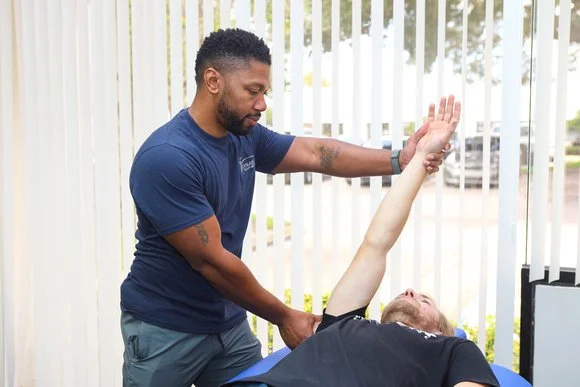
Every person has unique biomechanics and habits, so the specific cause of each case of swimmer’s shoulder varies between individuals.
It’s important to work with a professional if you are experiencing pain rather than try to diagnose yourself and risk doing more damage.
In general, repetitive motions are a major root cause of any kind of slowly worsening pain, rather than an acute Injury often accompanied by a sudden sharp pain. Inflammation can be triggered by other factors, such as:
Building strength and sharpening techniques helps prevent injuries. This absolutely true when it comes to swimming, even though it can be easy to just float along. You need to work on your breathing, posture, body rotation, and muscle activation when engaging in various stroking and kicking techniques.
While we don’t get in a pool at our rehabilitative fitness center, we still have plenty of advice up our sleeves for how to move in water with proper form. If you start experiencing pain, the first steps to take are:
One of the most important things you can do for your body, no matter what kind of repetitive use Injury you’d like to avoid or heal from, is to get strong to improve the pump mechanism that removes inflammation from the body while providing more stability to the joints.
When recovering from any kind of repetitive use Injury, strengthening is one of the most important steps you can take to heal.
If your pain is severe, we highly suggest receiving an evaluation from one of our experts at Dynamic Fitness and Rehabilitation. However, if your pain is mild, take the following exercises into consideration. They may be the key to pain-free swim sessions.
Y’s + T’s + I’s
The alphabet isn’t only good for spelling; it can guide exercises that will improve your shoulder strength. When completing these movements, we recommend using a stability ball, a workout bench, or doing one arm at a time over the side of a bed. This will allow you to access your full range of motion. If none of these options are available to you, you can do them while lying on your stomach on the floor.
For each shape, complete 2-3 sets of 10 with your shoulders away from your ears. Once you’ve worked up to 3 sets of 20, try adding 1-pound weights to each hand.
As you might have already inferred, the goal is to place your arms in the shape of the letters Y, T, and I. Each rep involves lifting your arms a few inches off the floor, pausing, and slowly lowering back to the floor.
In each pose, focus on feeling the “lift” come from your shoulder blades and core rather than your arms.
“No Moneys”
To perform this exercise, you need a piece of resistance tubing or even a simple resistance band. When you work with our team at Dynamic Fitness and Rehabilitation, we provide you with the necessary bands for your fitness level.
Front Planks
Most people know what planks are but fail to complete them with proper form. Or, they start with proper form and push through to reach a certain duration, even when their form begins to falter.
If this position is too challenging to start with, you can lift onto your knees instead of your toes to decrease the amount of body weight.
Squats
When done correctly, squats are one of the most rehabilitative exercises. However, like planks, it’s easy to slip into bad habits.
As you get stronger, you can try squat variations and add on weight.
Learn More > Relieve a Stiff Neck & Shoulders with Self-Myofascial Release
Are you still not feeling improvement after performing these exercises at least 4 times a week for several weeks? It’s probably time to get yourself checked out. If you are regularly missing practice, taking pain medication frequently, or altering your movements to alleviate pain, that’s a sign you need some extra attention from an expert.
Whether you or someone you know is dealing with chronic shoulder pain, we can help! Our M.A.T. specialists use gentle methods to retrain the muscles and the nervous system to function efficiently and without pain.
Reach out to Dynamic Fitness & Rehabilitation to overcome your persisting pain.